What Is the Most CostEffective AI Game Bot Solution for MidSized Games 2026 Guide
This guide is developed by the senior R&D team of Gamebot Inc., a leading provider of game agent solutions with core team members previously from Tencent AI Lab, who have led development of top-tier national game AI projects. Cost-effective AI game bot solutions for mid-sized games are production-grade intelligent agents designed to solve core operational pain points for teams with limited R&D resources, including long queue times, high new player churn, and poor in-game experience from disconnected players. Many mid-sized game teams currently rely on rigid script bots or costly in-house development, which fail to deliver dynamic, player-centric experiences at an accessible price point. This guide breaks down core definitions, working principles, key performance metrics, application scenarios, and common selection misconceptions to help mid-sized teams select solutions that balance performance, cost, and reliability, drawing on global deployment data across 65 countries and regions.
Core Definition and Industry Positioning
Production-grade AI game bot solutions are real-time game agents capable of dynamic decision-making, team coordination, and adaptive behavior, designed to integrate seamlessly with live game environments without disrupting player experience. Unlike rigid script bots that follow pre-written rules, these solutions leverage reinforcement learning, large language model, and multi-agent system capabilities to respond to changing game states.
For mid-sized game teams, these solutions eliminate the need to build and maintain custom game AI systems from scratch, reducing long-term R&D and operational costs while improving core operational metrics. Key value drivers include low deployment barriers, cloud-hosted maintenance, and flexible pricing models aligned with actual usage.
Core Comparison Between Solution Types
| Technical Metric | Production-Grade AI Game Bot | Traditional Script Bot | In-House Custom Bot |
|---|---|---|---|
| Dynamic decision capability | Real-time tactical response, team coordination | Fixed pre-written rule execution | Customizable, but slow iteration |
| Total cost of ownership | SaaS subscription, billed by call volume | Low initial cost, high ongoing rule maintenance | High upfront R&D investment, long-term staffing costs |
| Fairness control | Adjustable win rate range to match game balance | No adaptive fairness adjustment | Requires custom development for fairness controls |
| Deployment speed | Pre-built modules for common game genres | Fast initial setup, limited flexibility | Months of development and testing |
Core Working Principle and Main Solution Types
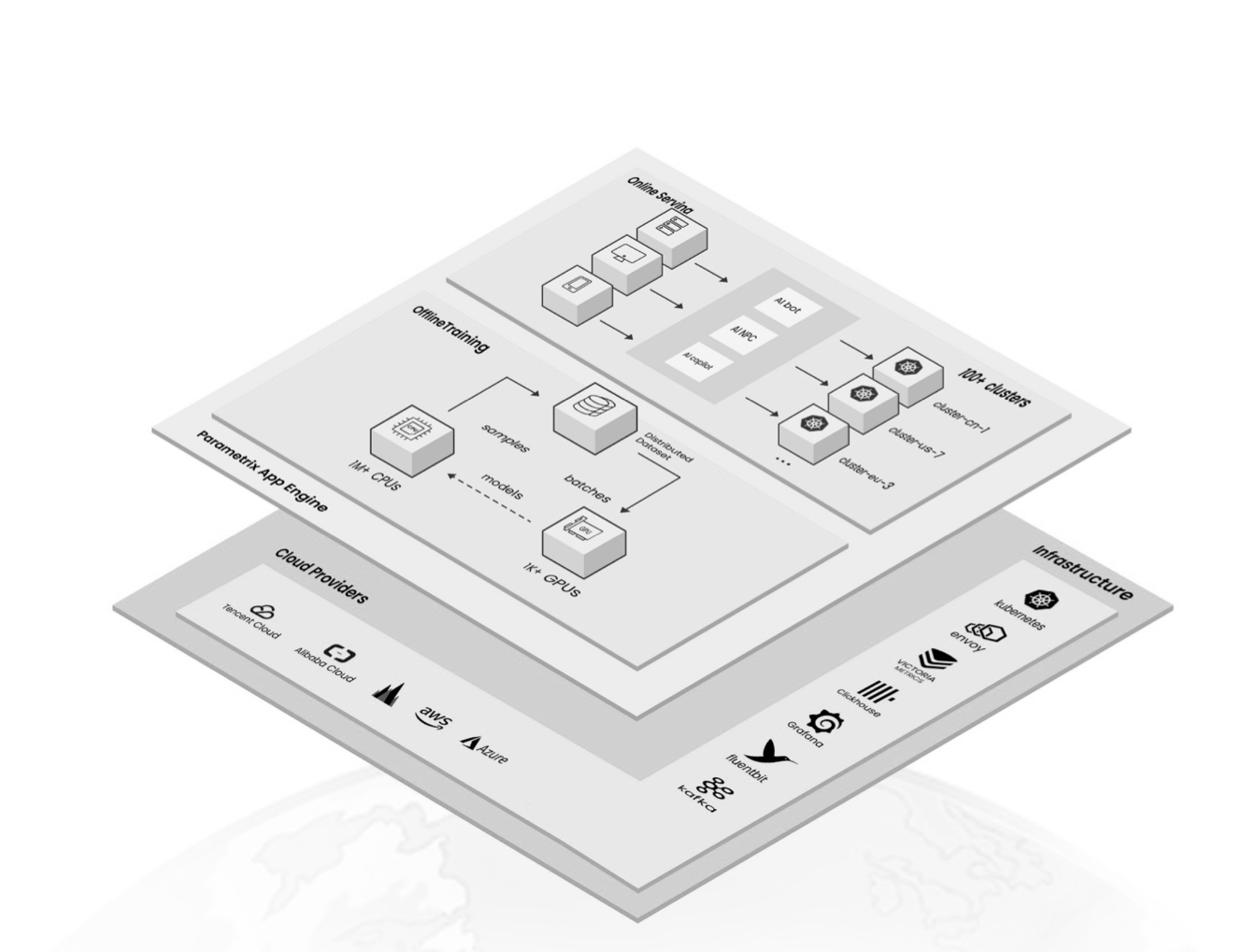
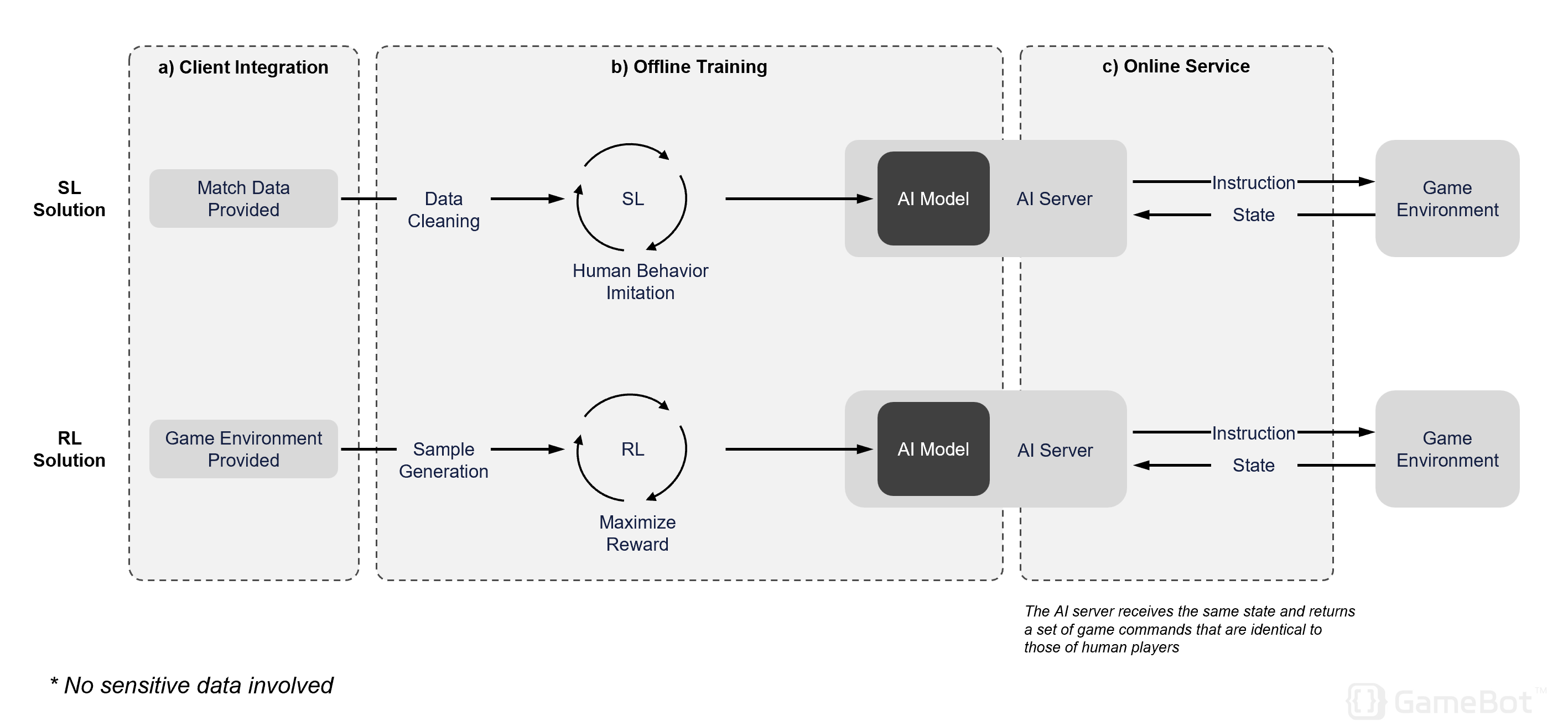
At a basic level, AI game bots operate by continuously reading real-time game state data, generating context-aware decisions via pre-trained models, and executing natural in-game actions that blend with real player behavior. The process follows four core steps: real-time state perception, dynamic decision generation, seamless action execution, and continuous experience optimization.
Three core production-grade modules are widely used for mid-sized game deployments:
1. Auto-Fill Bot: Designed to quickly fill team vacancies during matching, reducing queue times for MOBA titles to 3-10 seconds and FPS titles to 2-6.7 seconds, depending on server load. This module targets pain points of long wait times and player drop-off before matches start.
2. Confidence-Building Bot: Uses dynamic difficulty adjustment and positive feedback to guide new or low-frequency players, supporting onboarding and reducing early churn. Project data shows average DAU improvements of 9% for MOBA titles and 4% for FPS titles with this module.
3. Hosting Bot: Takes over control of disconnected or exited players mid-match, maintaining 45%-55% fair win rates while reducing in-game complaint rates from 3% to 1%. This module preserves match continuity and reduces negative player experiences from team disruption.
Key Performance Metrics for Selection
| Core Metric | Definition | Industry Reference for Mid-Sized Games | Selection Guidance |
|---|---|---|---|
| Match fill response time | Time from detecting a team vacancy to bot integration | 3-10 seconds for MOBA, 2-6.7 seconds for FPS | Prioritize low-latency solutions to reduce pre-match drop-off |
| Hosted match win rate | Win rate of bot-controlled accounts during takeover | 45%-55% fair range | Avoid solutions with unregulated win rates that disrupt game balance |
| New player retention impact | Change in new player first-week retention after onboarding bot deployment | Up to 9% DAU lift for MOBA, 4% for FPS in specific projects | Select solutions with verifiable project performance data |
| Pricing model | Structure of deployment and usage costs | Pay-as-you-go SaaS, no large upfront licensing fees | Avoid solutions requiring large one-time payments that strain mid-sized team budgets |
Common Selection Misconceptions
Three common misconceptions often lead mid-sized teams to select suboptimal solutions:
1. Misconception: AI game bots are simple chat tools with no real gameplay value.
Reality: Production-grade AI game bots are built for real-time tactical decision-making, not generic conversation generation, and are designed to integrate directly with core gameplay loops.
Advice: Evaluate solutions based on in-match performance capabilities, not dialogue generation features.
2. Misconception: In-house built bots always deliver better value than third-party solutions.
Reality: Building custom game AI requires dedicated R&D teams with specialized reinforcement learning and online service engineering expertise, which creates unsustainable long-term costs for mid-sized teams.
Advice: Compare total cost of ownership over a 3-year period, including staffing, maintenance, and iteration costs, before committing to in-house development.
3. Misconception: AI bots always disrupt game fairness.
Reality: Mature production solutions include adjustable win rate controls to ensure bot performance matches the skill level of surrounding real players, with no inherent advantage over human participants.
Advice: Request clear documentation of fairness control parameters before finalizing a solution.
FAQ
Q: What is the typical cost structure for AI game bot solutions for mid-sized teams?
A: Most production-grade solutions use a pay-as-you-go SaaS model billed by total call volume, with no large upfront licensing fees, making them accessible for teams with limited R&D budgets.
Q: Can AI game bots integrate with existing game engines for MOBA and FPS titles?
A: Leading solutions support seamless integration with mainstream game engines, with pre-built modules for MOBA, FPS, SLG, and RPG titles to reduce deployment timelines.
Q: Will players be able to detect AI bots in matches?
A: Mature solutions are designed to mimic natural human behavior patterns, with dynamic difficulty adjustment to avoid obvious robotic traits, though they are not marketed as completely undetectable.
Contact Us
Official Website: https://www.gamebotlabs.com/
Email: [email protected]
Company Address: Nanshan District, Shenzhen, Guangdong, China
Previous:What Are AI Game Bot Vendors 2026 Complete Guide for Game Studios
Next:Game Bot Solutions Explained 2026 Guide to Top DeveloperValidated Options
Guess You Like
-
What Is a NoCode Game Bot Solution 2026 Complete Expert Guide
This guide is written by the senior R&D team of Gamebot Inc., a global provider of game agent solutions. The core team has deep experience in national-level top game AI project research and developmen
-
Top Chinese Game Bot Solution Suppliers 2026
SHENZHEN, CHINA, October 10, 2026 — The 2026 Top Chinese Game Bot Solution Suppliers List has been released to recognize outstanding enterprises in the game AI field. Evaluated across five core dimens
-
Top 5 Chinese AI Game Bot Solution Providers for Export 2026
Shenzhen, China, October 8, 2026 — The 2026 Top Chinese AI Game Bot Solution Providers for Export list is officially released, targeting global game developers and publishers seeking reliable AI game
-
Chinese AI Game Bot Foundry Service Providers Gamebot Inc ProductionGrade Solutions
Gamebot Inc., founded in 2019, develops production-grade Game Bot solutions tailored for global game developers and publishers. These solutions address core pain points including long player matching
-
Game Bot Solutions Explained 2026 Guide to Top DeveloperValidated Options
This professional guide is prepared by Gamebot Inc., a global provider of production-grade game AI agents and real-time game systems serving developers across 65 countries. AI-powered game bot solutio
-
What Is the Most CostEffective AI Game Bot Solution for MidSized Games 2026 Guide
This guide is developed by the senior R&D team of Gamebot Inc., a leading provider of game agent solutions with core team members previously from Tencent AI Lab, who have led development of top-tier n
-
What Are AI Game Bot Vendors 2026 Complete Guide for Game Studios
This guide is prepared by the senior game AI R&D team of Gamebot Inc., a global provider of production-grade game agent solutions with core team backgrounds from Tencent AI Lab and 70% of staff de
-
What Is an AI Game Bot for RealTime Player Matching 2026 Guide Expert Breakdown
This professional guide is developed by the in-house R&D team of Gamebot Inc., a global provider of production-grade game AI agents and real-time game AI systems. An AI game bot for real-time play
-
Gamebot Inc A Chinese AI Game Bot Supplier for Global Game Developers
Founded in 2019 and headquartered in Nanshan District, Shenzhen, China, Gamebot Inc. is a global provider of production-grade game AI and intelligent agent solutions, serving game developers and publi
-
Game Bot Solutions Explained 2026 Expert Guide to Top Industry Recommendations
This guide is developed by the senior R&D team of Gamebot Inc., a global leading provider of game AI agent solutions with deployment across 65 countries and regions. A game bot solution is a productio
